 Innovation and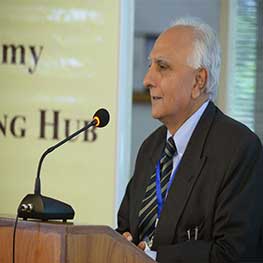
Dr. Shahid Amjad Chaudhry
This volume emerges from the 18th Annual Conference on the Management of the Pakistan Economy, hosted by the Lahore School of Economics. Over nearly two decades, these conferences have become an important forum for rigorous, policy-oriented economic research, bringing together academics, policymakers, and practitioners to diagnose the economy’s challenges and propose actionable solutions. This book is part of a longer-running series that reflects a sustained effort to develop a home-grown understanding of Pakistan’s growth challenge —grounded in the country’s specific institutional realities rather than generic prescriptions. Research produced within Pakistan, by those who understand the economy from the inside, is more likely to yield reforms that are both technically sound and practically implementable — and more likely to gain traction with the stakeholders who matter than prescriptions that arrive from outside. The theme of this year’s conference, The Imperatives of Growth and Trade, reflects a shift in focus from earlier volumes. In recent years, the priority was stabilisation — addressing a severe balance-of-payments crisis, reducing high inflation, and restoring international confidence. While that task is not complete, the most acute pressures have eased. The central argument of this volume is that Pakistan’s growth challenge is no longer primarily one of macroeconomic stabilisation, but of structural transformation under balance-of-payments constraints. Sustained growth will require relaxing these constraints through export upgrading, deeper integration into global value chains, and investment in the productive and institutional capabilities that higher-value growth demands. The question, therefore, is not whether to pursue structural reform, but how to sequence and implement it given Pakistan’s current constraints.
Macroeconomic Conditions
The volume opens with an assessment of the economy’s current position. The Lahore School’s Modeling Lab, led by Moazam Mahmood and Azam Chaudhry, together with Seemab Sajid, Amna Fatima, and Sara Qasim, estimates GDP growth for fiscal year 2025 at 2.44 percent — a modest recovery from near-zero growth in FY2023 and 1.7 percent in FY2024. Inflation has declined from a peak of 33 percent to around 8 percent, and the economy recorded a current account surplus this fiscal year. These are welcome developments, though the vulnerabilities underlying the earlier crisis have not been fully resolved. Kalim Hyder, Sabina Jafri, and Omar Saqib’s analysis of inflation persistence underscores that post-COVID inflationary expectations became self-reinforcing, and that anchoring them durably will remain central to maintaining price stability.
The Growth Constraint
Improved macroeconomic conditions have not yet translated into meaningful growth, and several contributions examine why. A consistent diagnosis across the volume is that Pakistan’s growth is constrained not by policy ambition, but by the balance of payments. Azam Chaudhry, Gul Andaman, and Aymen Junaid estimate Pakistan’s BOP-constrained growth rate at just 3.71 percent over 1996–2023, with actual growth remaining below even this ceiling. The key lever for raising it is reducing import income elasticity: liberalising imports of investment goods to stimulate capital formation, while curbing non-essential consumption imports. Naved Hamid and Murtaza Syed argue that maintaining a positive real interest rate remains appropriate given Pakistan’s history of boom-bust cycles, and that premature monetary loosening risks reigniting external pressures before reforms take hold. Moazam Mahmood, Shamyla Chaudry, and Muzzna Maqsood further show that capital outflows — estimated at approximately 2.3 percent of income — reduce domestic savings available for investment, and must be incorporated into any serious accounting of the investment–saving gap. Taken together, these findings point to a coherent policy challenge: relaxing the balance-of-payments constraint requires export expansion, which in turn depends on upgrading Pakistan’s position in global value chains and strengthening the domestic capabilities that support highervalue production.
Trade: External Threats
Trade is a central theme of this volume. Pakistan’s external vulnerabilities are increasingly evident, and several papers address them directly. As the home of Pakistan’s first WTO Chair, the Lahore School has developed a strong research focus in this area, and the papers by Chair Azam Chaudhry and co-authors reflect that commitment. Azam Chaudhry and Gul Andaman estimate that a 19- percent US tariff could reduce Pakistan’s exports by USD 0.40 billion in 2025, with cumulative losses of USD 2.11 billion over five years, concentrated in textiles. A companion study finds that the EU’s Carbon Border Adjustment Mechanism could reduce exports to the EU by USD 308 million by 2026, rising to USD 479 million by 2036, with both agricultural and industrial sectors exposed. These findings point toward a common policy response: enhancing competitiveness, diversifying export markets, investing in cleaner production, and aligning with evolving global standards. The window for adjustment is narrow, and the cost of inaction is measurable.
Trade: The GVC Opportunity
Beyond these external pressures, the volume examines Pakistan’s structural position in global markets. Rabia Arif and Azam Chaudhry show that Pakistan lags regional peers in global value chain participation, characterised by strong downstream but weak forward linkages that limit value addition. For a middleincome economy, deepening forward linkages — shifting from raw material supply toward higher-value manufacturing — offers the most effective route to improving export performance and GDP growth. The implication is that trade strategy must move beyond exchange rate management and tariffs toward actively building the productive base required for deeper GVC integration.
Industrial Upgrading
Building that productive base raises the question of what forms of industrial policy have worked elsewhere and what lessons Pakistan can draw from them. Rajah Rasiah provides a comparative analysis of Southeast Asia, showing how Singapore, Malaysia, Vietnam, and Indonesia used state-led industrial policy and foreign investment to sustain manufacturing growth and, in some cases, reach the technology frontier. A central lesson is that successful industrial upgrading requires a results-oriented state that combines incentives with accountability, embedded within a capable governance environment. For Pakistan, the question is not whether industrial policy is appropriate, but whether the institutional capacity exists to implement it effectively.
Energy and Governance
The volume also addresses domestic bottlenecks that continue to weigh on competitiveness, particularly in the energy sector. Rabia Ikram, Moazam Mahmood, and Muzzna Maqsood show that circular debt is driven less by tariff under-recovery than by fixed capacity payments embedded in power purchase agreements, which accumulate regardless of actual consumption. Reform must therefore focus on contractual structures and institutional incentives, rather than tariffs alone. Jamshed Uppal’s cross-country analysis of independent power producers highlights governance quality — government effectiveness, rule of law, regulatory standards, and control of corruption — as the key determinant of sector performance. Natasha Moeen, Mehreen Khan, and Theresa Chaudhry document the air pollution burden in Punjab’s transport sector and identify practical solutions, including electric vehicles, improved public transport, and better fuel standards. These constraints directly affect Pakistan’s cost structure and external competitiveness, reinforcing the broader case for structural reform made throughout this volume.
Looking Forward
The stabilisation achieved over the past two years has created conditions that did not exist in 2023. The contributions in this volume reflect a research agenda increasingly oriented toward the structural reforms required for durable growth. They point to a consistent set of priorities: raising the BOP-constrained growth ceiling by reducing import intensity and strengthening export competitiveness; integrating more deeply into global value chains; preparing for emerging carbon and trade constraints through proactive industrial and environmental policy; and addressing the energy and governance bottlenecks that continue to limit private investment. Read alongside earlier volumes, they also reflect a cumulative, evidence-based account of why Pakistan’s economy has evolved as it has — and what changes are required for it to perform differently.
Policymakers in the Ministry of Finance, the State Bank, the Ministry of Commerce, and the Planning Commission will find concrete, research-grounded guidance on the choices that matter most: where monetary policy should hold firm, which trade policy levers are most effective, what regulatory reforms can unlock the energy sector, and how the experience of successful developing economies can inform industrial upgrading. Academics and the business community will find analysis that speaks directly to the environment in which they operate. The challenge Pakistan faces is not simply to preserve macroeconomic stability, but to convert it into sustained and resilient growth — an agenda that is technically demanding and requires difficult choices and broad consensus, but one that this research suggests is both necessary and achievable.
Dr. Shahid Amjad Chaudhry Rector
Lahore School of Economics